
NAP
NAP refers to a daytime period of rest. It may be voluntary or involuntary, depending on one’s age and physical condition. It may be called a snooze, catnap, siesta or life-threatening coma…depending on one’s age and physical condition.
Some words seem to relate to napping but don’t. A dozer, for instance, weighs about 49 tons and works far harder than a napping senior. Restrooms are an unsavory place for actual napping. Remember that.
Some words that do relate to napping are not easily understood, either, particularly if one is new to English. Have a kip could mean “Please take this fresh animal hide, with my sincerest thanks.”
Equally puzzling, “I’m getting forty winks” might mean you’ve taken a walk in your underwear again. Also, the command to “Get some shut-eye” might be from an angry colleague, wishing a rare tropical infection on you.
 NATURAL
Disclaimer: I have no medical credentials recognized by anyone anywhere. I have a driver’s license and Hallmark frequent-shopper card. Naturally, I struggle to see my personal value; therefore, be wary of anything mentioned here.
GERD Yourself Against Some Medications
GERD (Gastroesophageal Reflux Disease) feels as bad as it sounds. Hydrochloric acid gets confused and goes north, into the food pipe, instead of staying in its own gated community: the stomach. Neither metal nor rubber, the food pipe is also called the esophagus—a word that could have meant “nightclub” in Ancient Greek.
The esophagus is actually more like the Lincoln Tunnel, carrying food between New York and New Jersey. New York is a throat, and New Jersey is a dark place where acid pummels food. When the tunnel entrance doesn’t close properly in New Jersey, acid floats into the tunnel toward New York. This is bad; both New York and tunnels don’t like hydrochloric acid.
Some prescription medications reduce New Jersey (stomach) acid to the point where food doesn’t break down enough to be useful. This can lead to bone problems in old people and even in me. Therefore, natural ways to deal with GERD are superior, in my uninformed opinion.
One natural option is to go rafting; but instead of sitting in a raft, it sits in you—at the bottom of the food pipe (esophagus). To get the raft, one chews a raft-inflater, otherwise known as alginic acid. Too much alginic acid isn’t good, so it should never be part of a homemade recipe, in things like alfredo sauce or a mango smoothie. Only professionals know how to make safe rafts.
I personally wouldn’t go rafting every single day, and some rafts are better than others. My favorite is from a company called Life Extension in Florida. The company has been around for eons; and these chewables are usually tasty, unless aging has made everything taste the same. In that case, why not just let the GERD take you on to heaven?

Try Magnesium as a Couple
If you and your bedroom slippers glide into a room and can’t remember why, that’s perfectly normal. If you can’t name the room (kitchen, bathroom), that’s less normal. If you wonder whose toes extend from your slippers, that’s worth noting.
After six decades or more of experiences and data, most brains need outside help…like the ingenious coupling of magnesium (a mineral) and threonine (an amino acid). When married, they become Magnesium L-Threonate (MgT) and are dynamic.
To understand MgT, it would help to explain BBB. I guessed BBB meant either a European vacation (bed, bath, breakfast) or an all-inclusive weekend with the Amish (barn, baked goods, buggy). In health circles, BBB means blood-brain barrier. I find it comforting that a brain is a fortress, rather than an internet café.

Most ingested drugs recoil in horror when asked to face the barrier around the brain. For pills, the BBB is talked about in hushed tones—a place of doom, a drop off the edge of the world. Though vitamin C, E, taurine and turmeric fight their way through; most drugs and supplements flounder in the blood (the Atlantic) or the liver and never help the brain (Boca Raton).
Magnesium L-Threonate does leap the barrier, and the good news doesn’t stop there. The rat community was all abuzz with the news that an MgT study improved aging rats’ brains to the point where they performed new tasks as quickly as young, millennial rats.
Consistent ingestion of MgT also improved short-and-long-term memory in rats. In general, the rodent community welcomed these study results as a breakthrough for longevity and quality of life.
Then, there were three clinical trials involving people, in which 1500-2000 mg. of MgT were given to older adults with less-than-optimal brains…but still undeniably smarter than rodents.
After 12 weeks, MgT boosted cognitive performance in these people and reversed brain aging by more than 9 years. Though encouraging, I found no data about reversing gravity damage (thighs, neck) by even 6 months. That curbed my enthusiasm.
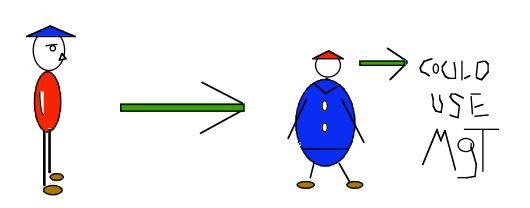
An interesting/horrifying fact is that brains shrink as we age. (See illustration below.) Why not stomachs? If I were God, I’d fix that.
MgT helps to stop the death of synapses—the brain’s wireless system—and to form new ones in the hippocampus. (I assumed hippocampus was the technical term for aging derriere.) The hippocampus is the brain’s long-term memory center, and MgT perks it up. Therefore, magnesium L-threonate is a winner for both human and rodent populations.